Water colours
Watercolours are usually overshadowed by acrylics, as they can be unpredictable and uncontrollable for many beginners. However, if learnt, watercolours can be a tool that gives you the ability to create a range of masterpieces. Furthermore, watercolor artworks can be easily done in less time.
After learning watercolors, one can use the ratio of water and pigment to create soft, hard strokes, and to even create dull and strong values as well.
The Origin of Watercolors
Various forms of watercolour painting have existed around the world since the palaeolithic period. The actual makeup of these early “watercolours” could vary dramatically. Some involved vegetable pigments, others used ink or soot. But the common factor, as you might guess, was always the use of water for dilution and application of the paint.
Watercolour paint that’s closer to what we would recognize today, emerged in Europe during the Renaissance and Baroque periods. However, at that time it was mostly used for sketches and copies, or nature studies. These works were often either in preparation for the “real” artwork or matters of scientific documentation.
Later, in the 18th century, watercolour paints became popular with mapmakers and engineers who found it useful for depicting terrain and project plans. At the same time, it became a fashionable pastime for the well-to-do and seen as an attractive skill indicative of a good education.
Watercolour paint in fine art also began around this time. The artists generally credited with establishing watercolour as a mature painting medium are Paul Sandby, Thomas Girtin, and Joseph Mallord William Turner. These artists (among others) developed and refined various techniques, creating a number of incredibly popular works, and infusing watercolour painting with new prestige.
The watercolour paint that we’re most familiar with today, however, was developed in the early 19th century. This type of paint is primarily composed of a pigment, gum Arabic, a binder, and an additive (like glycerine) to fine-tune the consistency. This paint is then mixed with water when used - thus the watercolour pallets we’ve come to know and love.
Source: Welight Art Space - Art Classes
Watercolour paint continues to be a popular medium for many artists today. Notable recent and current artists include Georgia O’Keeffe, Edward Hopper, and Andrew Wyeth, just to name a few. Not to mention the millions of students who express themselves through watercolour every year in art classes around the world.
Source: Prang - A Brief History of Watercolor
Useful videos for Watercolors
Documentry of my own Artpieces
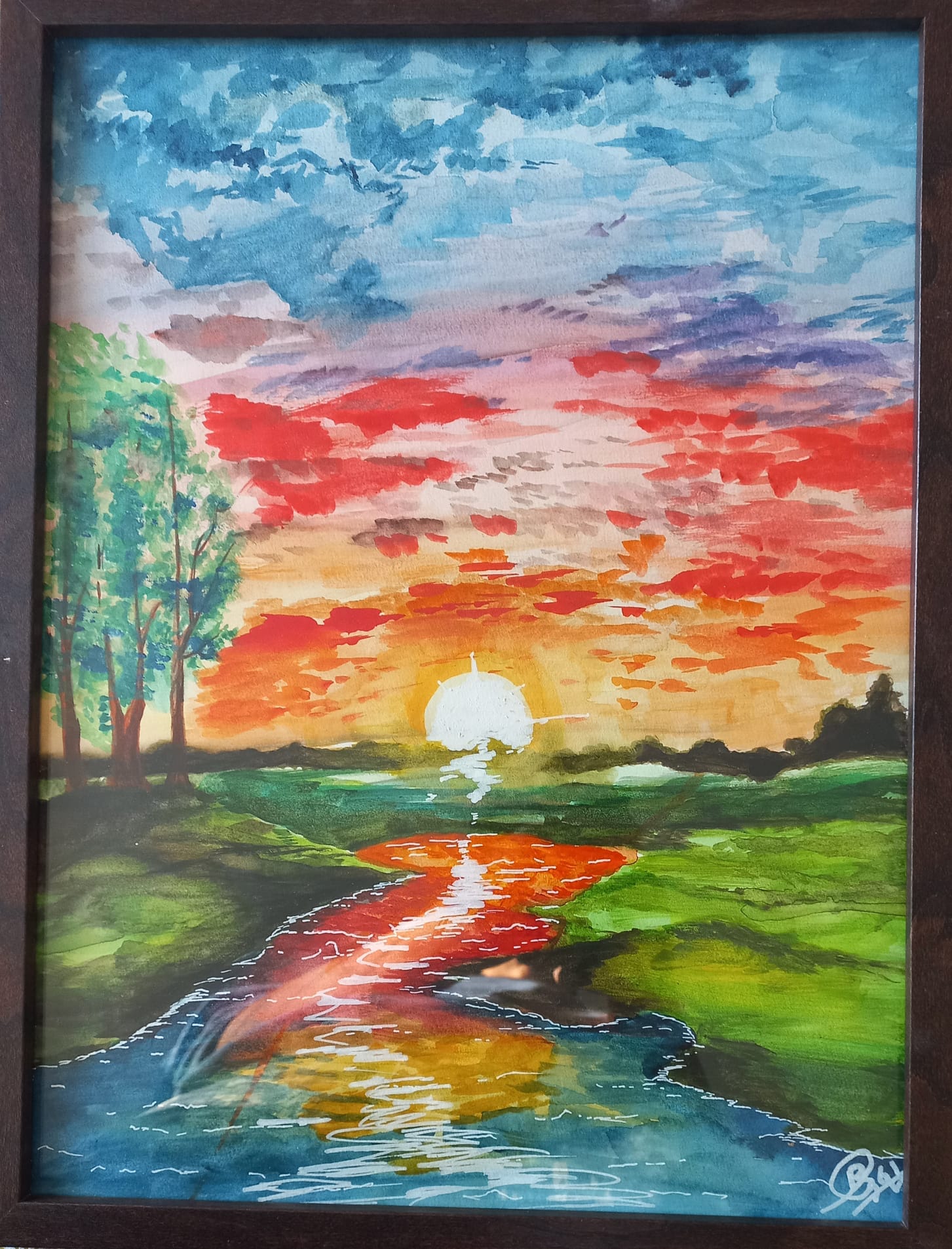
“Sunset”
The medium of this art piece is watercolours, and it is done on a cold-pressed 300gsm A3 paper.
Materials I have used are:
- Watercolour
- Pencil
- Eraser
- Posca markers
- Sharpener
- 300GSM A3 paper
This art piece is one of my personal favourites, not just because it’s my first A3-sized artwork, but because it feels like a milestone in my creative journey. I poured so much of myself into it. The colourful theme is exactly what I adore about working with watercolours — the way they blend, bleed, and glow together like they’re alive. What I wanted to portray was a beautiful countryside sunset, the kind that makes you stop and breathe for a moment because nature is showing off. Every stroke was my attempt to capture that warmth, that softness, that fleeting magic of daylight melting into evening.
This piece reflects my love for nature and my deep affection for watercolours, which have become one of my most used and most beloved mediums. They’re easy to work with, quick to respond, and yet never sacrifice beauty — if anything, they enhance it. Creating this artwork felt like letting my imagination run free while still staying grounded in something real and peaceful.
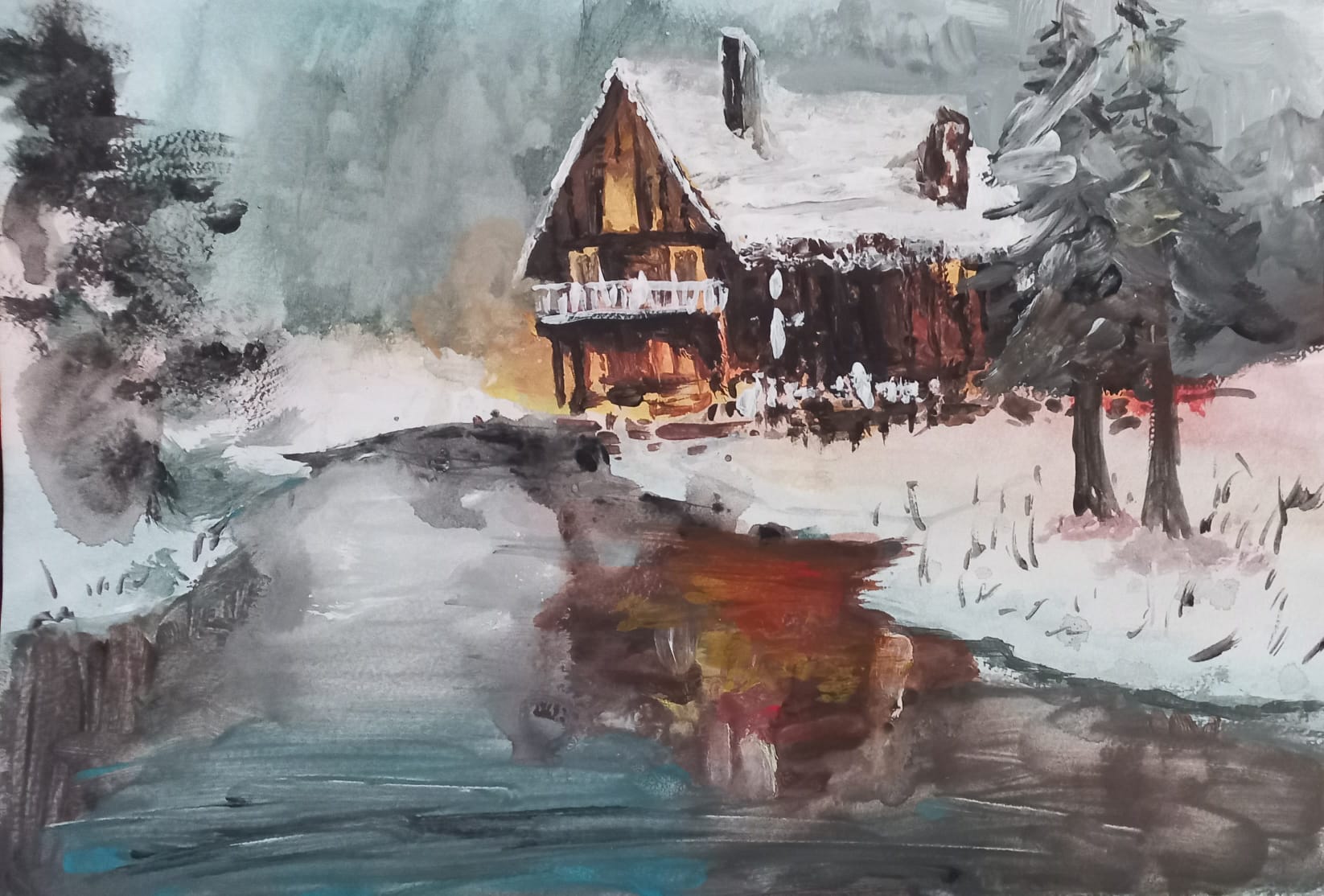
“Winter Cabin”
“Winter Cabin” is a watercolour artwork where I allowed my imagination to run completely rogue, drifting freely into the serenity of a world covered in snow. Spending it tucked away in a warm, cosy cabin surrounded by untouched snow is an experience that stays with you forever — a feeling that you will never forget, especially in regards to my love for skiing.
I created this piece using only watercolours on cold pressed paper, a simple setup that let me dive straight into painting without worrying about complicated materials. The textured surface allowed the pigments to settle naturally, giving the winter scene a soft, organic depth that supports the mood.
One of my favourite aspects of the artwork is the way the warm, golden light spilling from the cabin windows stands in striking contrast to the icy blues of the snow. That juxtaposition — heat against cold, shelter against wilderness — creates the emotional core of the painting. I’m also deeply proud of the lake and its reflections; the stillness of the water adds a quiet magic that ties the whole scene together.
Moreover, watercolour demands preplanning above all else. You can only move darker, never lighter, and the medium is far from opaque. That’s exactly why I intentionally left a light-yellow space at the very beginning of the process — to amplify the glow of the cabin and the lights in the painting later on. That small decision became one of the strongest elements of the entire piece.
But like every artwork, this one carries its regrets. There’s the accidental red blotch I dropped into the cabin’s reflection when I was rushing, and of course, the trees — trees that ended up looking far more childish than I intended. They’re the one part of the painting that didn’t quite live up to the vision in my head.
Still, despite its imperfections, this artwork captures a moment, a feeling, a winter dream — and that’s what makes it special.