Acrylics
The beauty of acrylics, that attracts many artists, is its ability to fully mask flaws. Unlike watercolors, acrylics can be fully opaque, meaning that you can paint on top of a mistake to fully cover it.
Acrylic paint is a fast-drying medium composed from pigment particles held in an acrylic-polymer emulsion. Dissolvable in water, it can be applied in thick streaks or thin washes and is known for its vibrancy of colour. Famous artists exploring acrylic paint include David Hockney, Damien Hirst, Tony Swain and Phyllida Barlow.
The History of Acrylic Paint
Acrylic paint is relatively new art material, created and popularised in the twentieth century. The earliest versions were developed for industrial use in the 1930s by the German chemical company BASF, made from an acrylic resin dispersion. In 1946, American artist and paint manufacturer Sam Golden (the later founder of Golden Acrylics) and his uncle, the artist Leonard Bocour, developed an acrylic, plastic based paint known as Magna Paint in New York. In contrast with oils, it had a synthetic vibrancy of colour and a glossy finish; these qualities made acrylic paint popular with a new brand of experimental artists searching for ways to break with tradition in favour of modernity. Water based acrylics were later invented in the 1950s and have remained popular since.
Source: National Galleries - Acrylic
Leonardo Da Vinci, Mona Lisa, 1503-19

Documentry of my own Artpieces
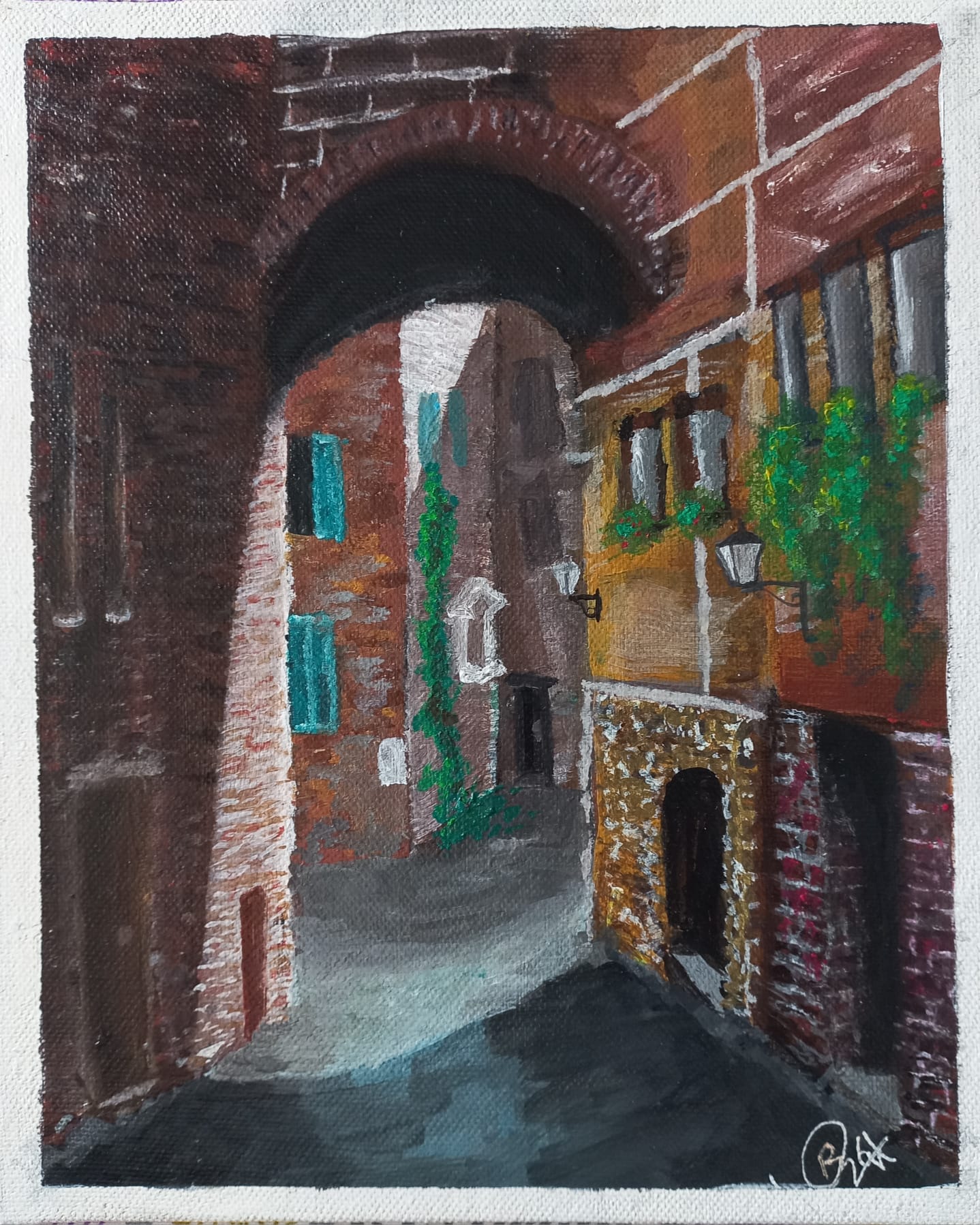
“Evening Alley”
The medium of this art piece is acrylics, and the surface I have used is a canvas.
Materials I have used are:
- Acrylic paint
- Pencil
- Eraser
- Sharpener
- Canvas
“Evening Alley” is an acrylic painting on canvas where I aimed to capture the quiet charm of a narrow street bathed in soft evening light. The warm tones of the brick walls and the cool shadows create a balance between calm and mystery, while the ivy climbing up the façade and the archway in the distance invite the viewer deeper into the scene. The bluish hue of the shadows gives the buildings a sense of depth and life, as if the alley itself is breathing under the fading light.
I created this piece using acrylics on canvas, a medium that allowed me to work freely and intuitively. One of my favourite aspects of the painting is how the lemon yellow tones subtly enhance the warmth of the scene, adding vibrancy and contrast to the cooler shadows. That small colour choice ties the composition together and evokes the lingering glow of daylight on aged stone.
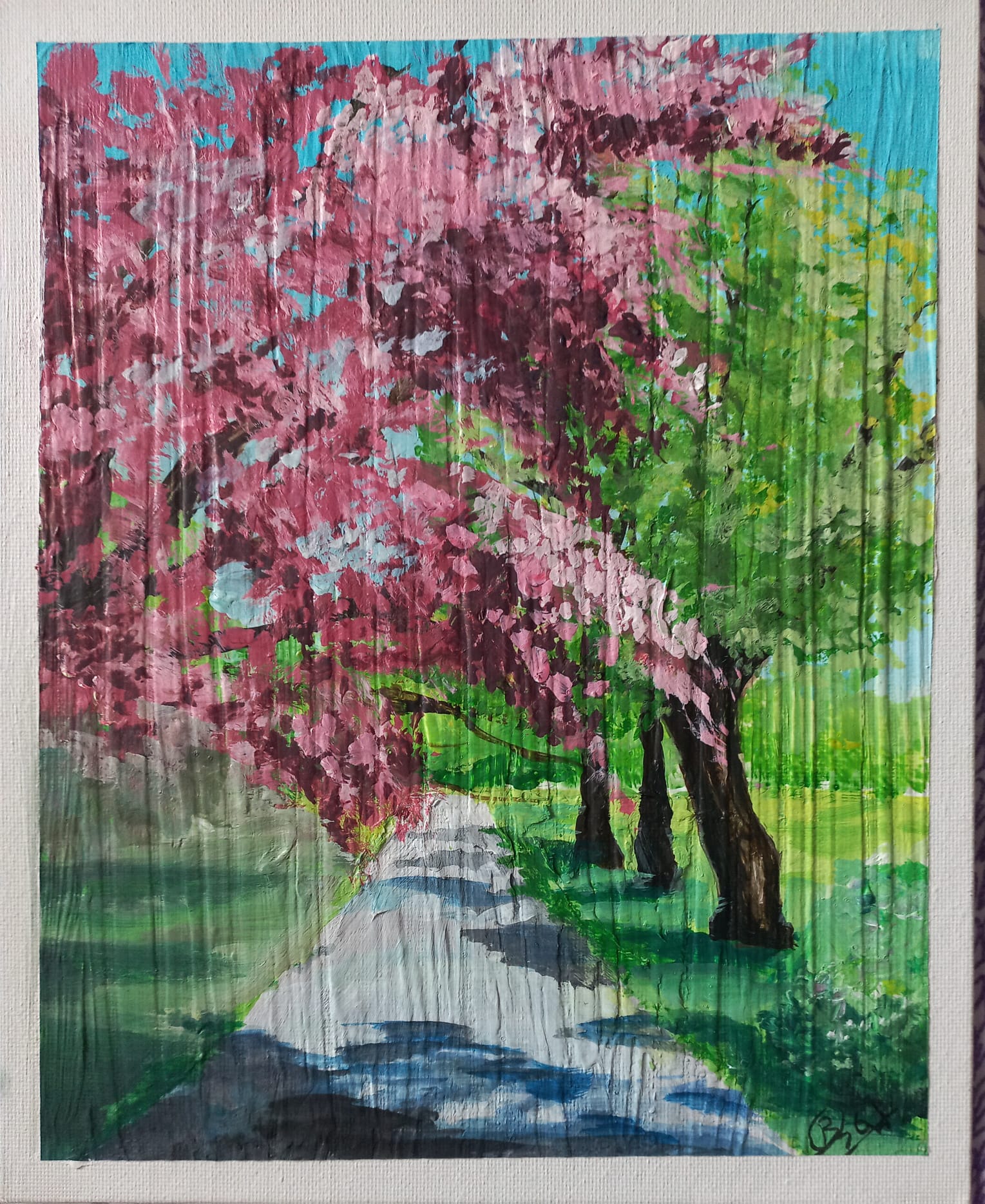
“A Walk in Summer”
The medium of this art piece is acrylics, and the surface I have used is a canvas.
Materials I have used are:
- Acrylic paint
- Pencil
- Eraser
- Sharpener
- Canvas
This artwork is an acrylic painting on canvas, capturing the feeling of a bright summer walk. The vivid colours bring the scene to life, with the cherry blossom on the left acting as a strong foreground element that immediately draws the eye. One feature I particularly enjoy is the way the shadows turned out — their soft, bluish hue gives the trees a sense of depth and movement, almost as if they’re breathing in the warm summer air.
Building on that, the process behind the painting is just as important as the result. A common misconception many artists have is painting the first object they notice — in this case, the tree — but acrylics work in the complete opposite way. Because acrylic paints are opaque, the correct approach is always to paint from back to front, building the scene layer by layer. This is very different from watercolours, where you work in transparent layers across the whole piece. Understanding this helped me structure the painting more effectively.
Finally, I’m also pleased with how the lemon yellow tones helped convey the cheerful, sunlit greenery of summer. That small colour choice added a warmth and vibrancy that ties the entire composition together.