Color Pencils
Coloured pencils are precision-based art tools featuring a pigment core held together by wax or oil binders and encased in a protective wooden sleeve, making them a favorite for artists who prioritize control, portability, and intricate detail. Their primary advantage lies in their unmatched ability to produce fine lines and realistic textures through patient layering and blending techniques.
Unlike "wet" media like oils or watercolours, they require zero drying time, produce no hazardous fumes, and are remarkably clean, allowing for a professional-grade studio experience even while traveling or working in small spaces. High-quality brands, such as the buttery wax-based Prismacolor or the harder, lightfast oil-based Faber-Castell Polychromes, allow artists to build deep saturation and smooth gradients that can rival paintings.
However, these benefits come with distinct challenges, most notably the significant time investment required to cover large areas and the difficulty of correcting mistakes; once the paper’s "tooth" or texture is flattened by heavy pigment, erasing becomes nearly impossible. Furthermore, coloured pencils are physically delicate, as the internal lead can shatter if the pencil is dropped, leading to frustrating breakage during sharpening.
Wax-based varieties are also prone to "wax bloom," a foggy white oxidation that can dull the artwork over time if a fixative isn't applied. Despite the high cost of professional-grade sets and the physical strain of long drawing sessions, they remain a versatile and essential medium for illustrators and hobbyists alike, provided they are paired with high-quality, textured paper and a refined technique that emphasizes light, gradual pressure over brute force.
Source: Twinkl - Colored Pencils
Early History of Coloured Pencils
An Early History of coloured pencils is not too well documented. It is known that Ancient Greeks used wax-based crayons, and Pliny the Elder recorded that Romans also used coloured crayons based on wax. The first coloured pencils appeared in the 19th century and were used for “checking and marking.” Staedtler, a German company owned by Johann Sebastian, invented coloured oil pastel pencils in 1834. Production of coloured pencils for art purposes started in the early 20th century. The first art colour pencils were invented and produced in 1924 by Faber-Castell and Caran d’Ache. Berol started making its coloured pencils in 1938. Other manufacturers that made colour pencils during the late 30s and early 40s were Derwent, Progresso, Lyra Rembrandt, and Blick Studio. Few manufacturers claim that they invented the first (art) watercolour pencil.
Documentry of my own Artpieces
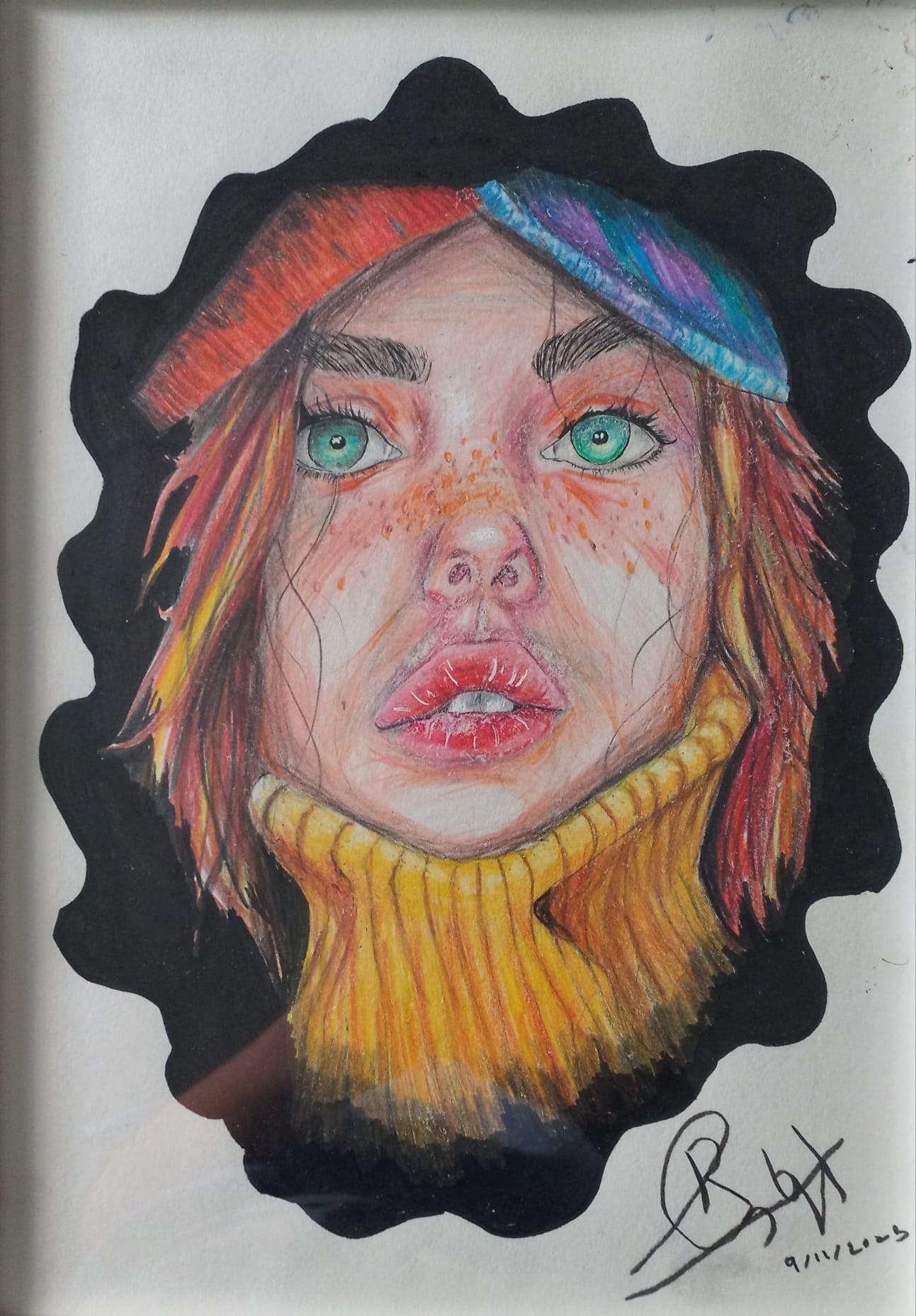
“Quite Radiance”
The medium of this art piece is colour pencils and the surface I have used is A4 hot-pressed paper.
Materials I have used are:
- Colour pencils
- Pencil
- Eraser
- Sharpener
- A4 hot-pressed Paper
“Silent Radiance” is a coloured pencil portrait that I created to explore emotion through subtle expression and vibrant detail. Undeniably my favourite part of this piece — they carry a brightness and intensity that immediately draw you in. I wanted them to feel alive, full of personality and emotion, almost as if they were about to speak.
Colour pencils were the perfect medium for this artwork. Their precision allowed me to shape the hair with delicate, flowing strokes, building depth and movement through layers of colour. The beauty of coloured pencils is how they let you create softness and detail at the same time — every strand of hair, every highlight, every shadow becomes intentional.
In this piece, I wanted to express a sense of individuality and quiet emotion. The contrast between the vivid eyes and the warm tone of the hair creates a feeling of energy and softness working together. It’s a portrait that whispers rather than shouts — a moment of emotion captured through colour, texture, and gaze.
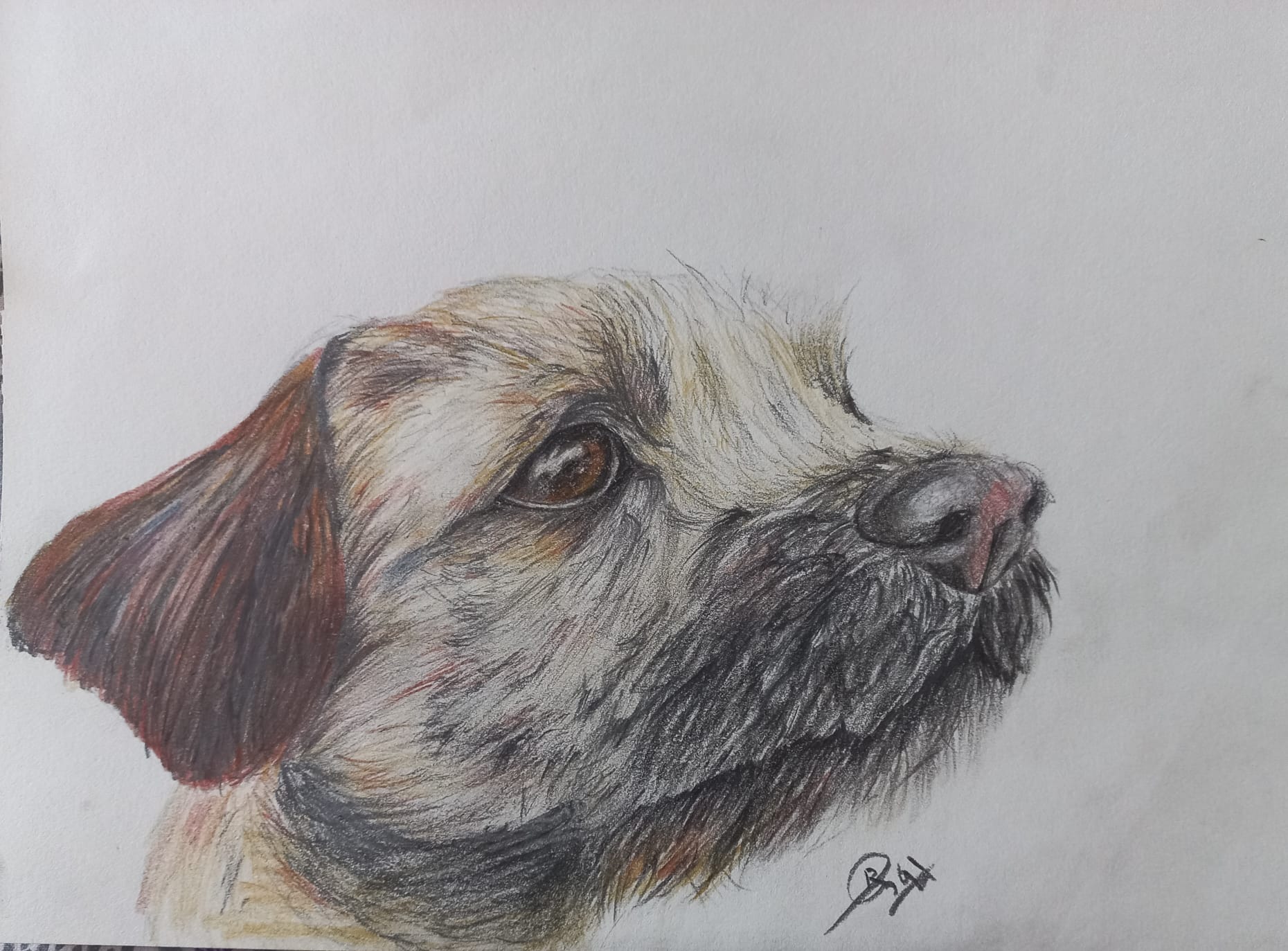
“Silent Gaze”
The medium of this art piece is colour pencils and the surface I have used is paper.
Materials I have used are:
- Colour pencils
- Pencil
- Eraser
- Sharpener
- Paper
“Silent Gaze” is a coloured pencil drawing that I created to capture the quiet intensity of an animal’s expression. I wanted the viewer to feel that moment of stillness — the kind of gaze that says everything without a single sound. The eye became the centre of the entire piece, holding all the emotion, softness, and depth I wanted to express.
Working with colour pencils allowed me to slowly build the fur, layering stroke after stroke until the texture felt alive. There is something incredibly beautiful about how colour pencils behave when drawing hair or fur — the way each line can be controlled, softened, blended, or sharpened to create realism. But it also meant sacrificing time as colour pencils is one of the longest medium to use. Furthermore, I focused on subtle shifts in tone and shadow to make the fur feel natural, warm, and touchable.
For me, this artwork is about connection. It’s about capturing a moment where emotion is communicated through a single look — a silent, powerful gaze that stays with you long after you stop drawing.